1. Me as a learner: Has my educational philosophy shifted?
The short answer is "No". The longer, more philosophical answer may be that the roots (my education philosophy) from which my practice as an educator keeps growing outwards have grown thicker and deeper. My the PGCert journey, the work with Virna (PGCert Course Leader), colleagues, mentors, and students, as well as my engagement with SoTL have only reinforced the assumptions, convictions, and theoretical underpinnings laid out in my education philosophy and the reflective rational presented elsewhere on this page. While I do not consider my educational philosophy to have shifted significantly I have learned plenty about myself, the craft of teaching, and my role as an educator. For many of the methods, tools, and approaches to learning and teaching which I had previously already considered and/or practiced to varying extent (such as TPS, intentionally equitable hospitality, conversational framework, student talking time - STT)) I was finally able to name them, which in turn allowed me to research and read more about them, and develop stronger practices. Meeting educators from across the University, its different schools, and thus individuals with greatly different subject-matter expertise also benefitted my learning as it opened multiple perspectives into how learning can be facilitate and how lecturers, seminars, and workshops take shape and take place across diverse subjects such as fashion, design, film, computing, business and more. While different in subject-matter, I recognised how many of the approaches and tools we use in our classrooms can be quite similar and effective with (often) only minor amendments in our own classrooms. This was particular true and enlightening when we shared and discussed "sticky topics" in one of our PGCert sessions: we may (I certainly do) sometimes believe that the challenges, issues, and problems we have are unique to us and are thus because of us (and our practice). Whether that students not attending class, not engaging fully in class, being distracted or distracting in class, not appreciating classroom activities, not completing formative assessments, struggling with summative assessments, and so many more. However, the PGCert helped me understand that all these are common and far from being unique to us as individual educators. As such, the PGCert journey has been particularly rewarding not only as a learning but a reflective journey which provided the (safe) space for critical and intellectual introspection as well as shared reflections as a group of educators and academic in pairs, triads, and as a class.
2. Theory ↔ Practice: How has the PGCert helped bridge the gap?
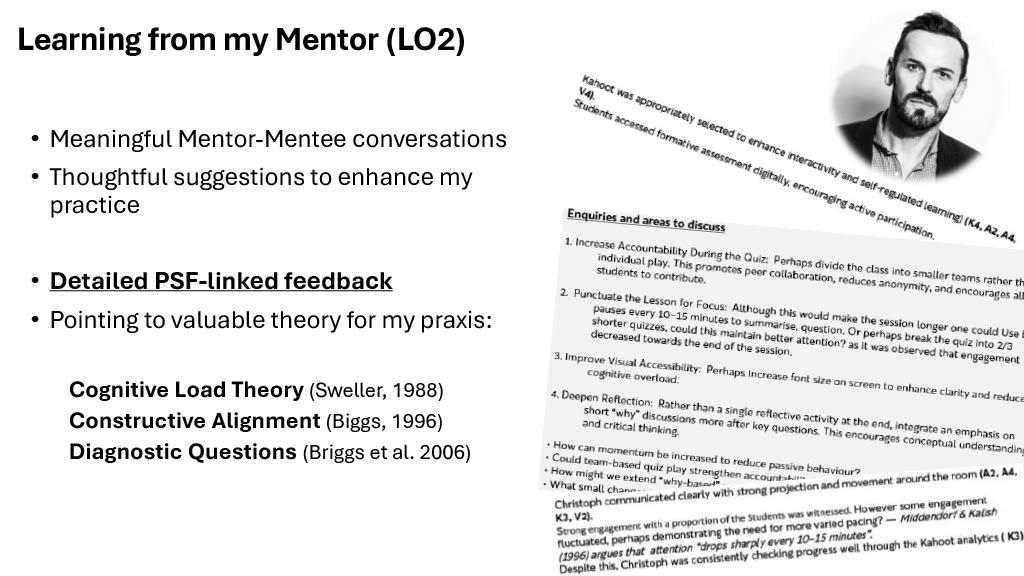
As alluded to above, the PGCert has been particularly successful in putting names (and thus research, authors, theory, reflection) to various aspects of my practice. Only by being able to name some of the approaches, models, methods, and tools I have previously used to varying extent was I enabled to develop these further, based on the thinking and writing of more experienced educators who have reflected and written so extensively about their own practice. Have to thoroughly reflect on and being observed for two learning activities also played a bigger role in bridging the gap between theory and practice as particularly my mentor (Stuart!) offered immensely valuable and thoughtful suggestions for further reading and theory to enhance my practice.
3. Looking back on the journey: What's worked well on the PGCert so far? What could be better?
Since we (I) have started the PGCert journey in September 2025, the experience has been deeply rewarding and enriching. Naturally, the degree of learning and growth that takes place is greatly dependent on the level of engagement that each of us (academics enrolled in the PGCert) can effort. Prioritising the PGCert can be immensely difficult and can often take a backseat vis-à-vis one's teaching, research and admin duties as well as non-working life. Having said this, I believe Virna (PGCert Course Leader) has made it as straightforward (which doesn't mean easy!) as possible by providing an excellent example of scaffolding in higher education. The outstanding level of support and guidance offered in-person during and outside of classes as well as digitally through Padlet and Canvas allowed me to confidently navigate the workload, develop professionally, and prepare for all parts of the assessment.
One aspect that could further enhance the PGCert is to build in a dedicated subject-matter focussed opportunity for exchanging thoughts, ideas, and resources. While the triads may (or could) do so to an extent, they do not do so consistently. While in some cases triads were explicitly fashion, business, or screen/film focussed (i.e. all 3 members of the triad were from the same course/department) others, as in my case, were more mixed (e.g. business, cyber security, game art). Naturally both constellations have their pros and cons. One approach could be to use mixed triads (such as mine, with members from across the university/schools) while offering an additional subject-specific forum based on subject matter (i.e. business, fashion, etc.). While the former (triad) could serve its purpose as it has done in this iteration of the PGCert, the latter could become a growing group/network/forum of subject-matter experts at Ravensbourne, growing with each iteration of the PGCert, building a community of practice focussed around the scholarship of learning and teaching in the context of a particular discipline of the University.
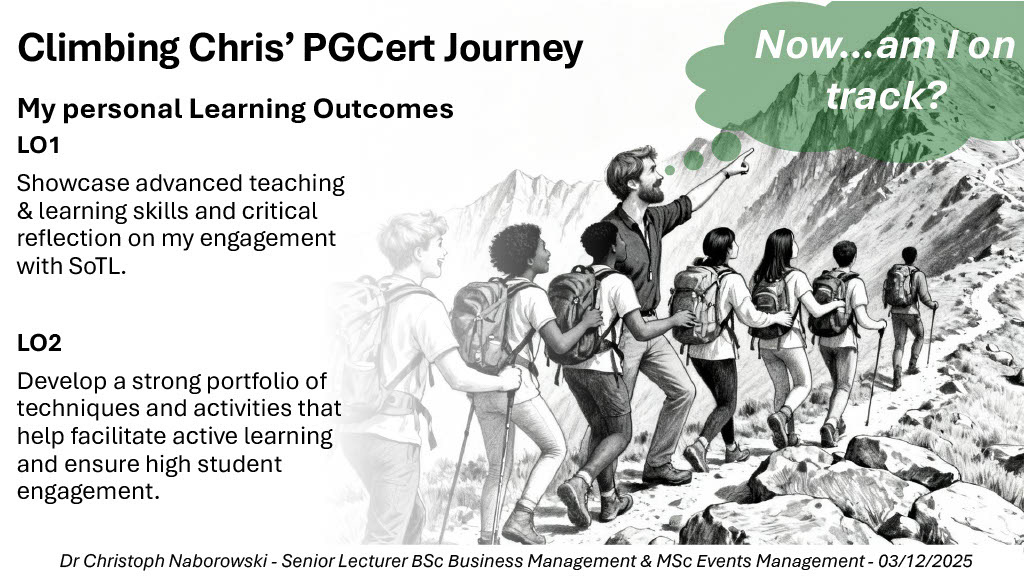
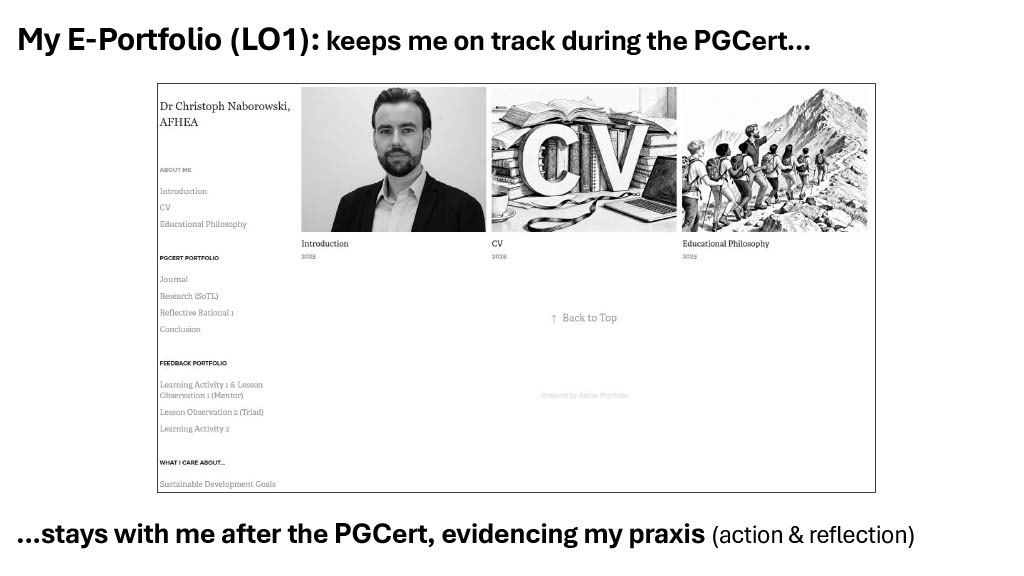
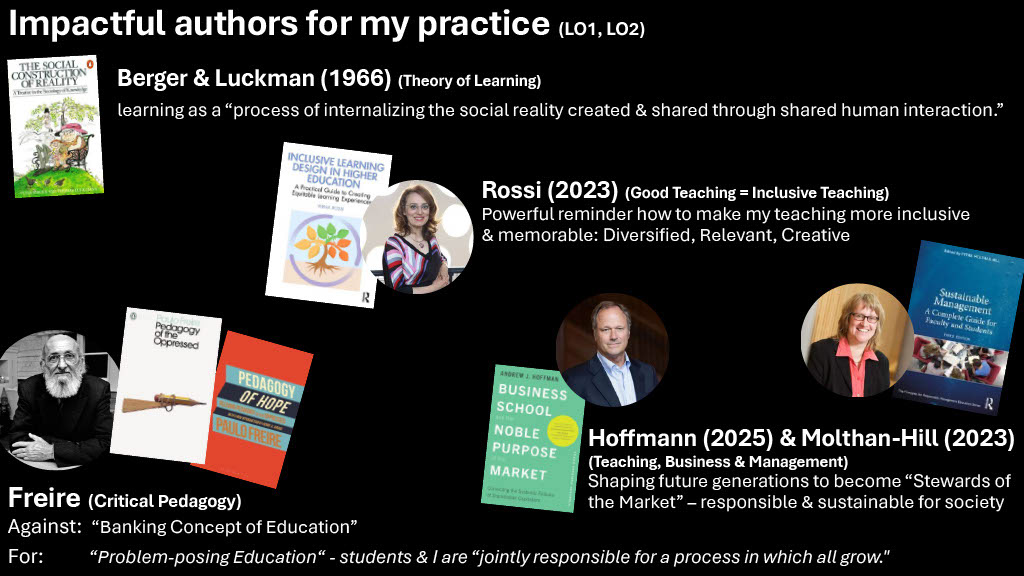
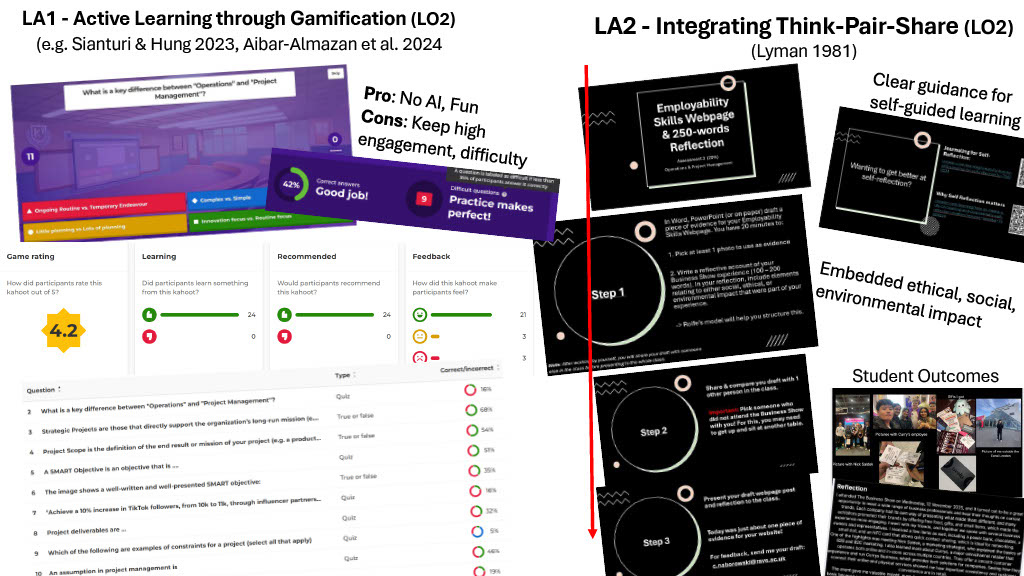
Module 1 Presentation Slides
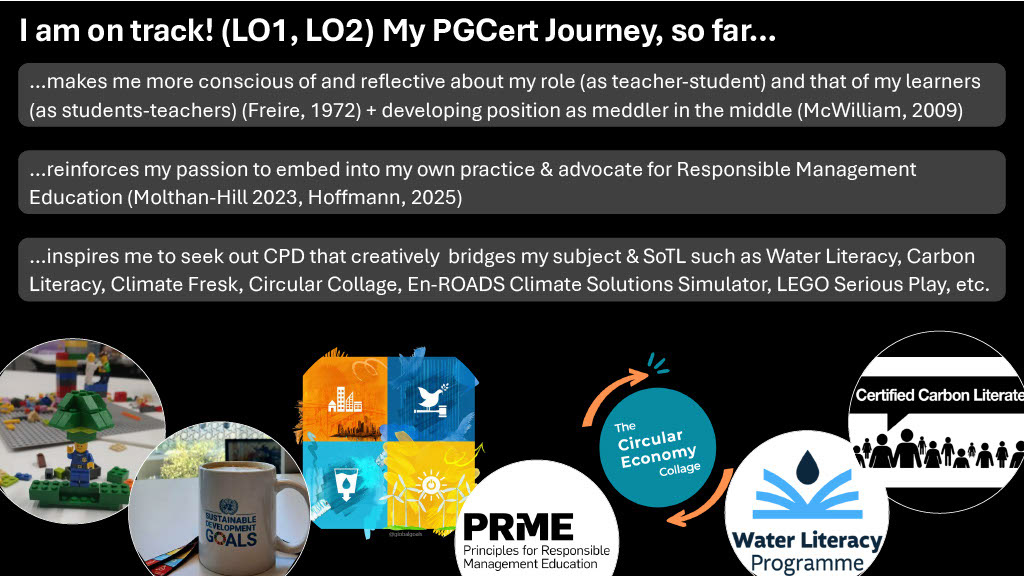
I presented the following six slides during our final PGCert session of 2025 to a number of peers on the PGCert course. This presentation allowed me to expose myself and my journey to date to my colleagues and gain valuable feedback from them. The feedback received was incredibly positive as well as supportive. The main takeaway for myself is to reflect more deeply on the inclusivity aspects of my learning activities and how I ensure that these are embedded within everything I do with my students.