Introduction & Reflection on my Education Philosophy
As an educator in Business Management, I am a strong advocate of responsible management education delivered in inclusive, supportive learning environments. This commitment is deeply rooted in my educational philosophy, which positions me as a facilitator of discovery and companion in exploring unfamiliar territory, with profound respect for my students' unique backgrounds, individual perspectives, and ambitions. I see teaching and learning as fundamentally collaborative endeavours in which we co-construct knowledge, drawing on the rich diversity of experiences and viewpoints that we all bring to the classroom (V1).
My educational philosophy is grounded in social constructivist theory, particularly the work of Lev Vygotsky, and extends to social constructionism more broadly, as articulated by Berger and Luckmann (1966). These theoretical frameworks shape my worldview and inform my approach to teaching. More recently, engaging with Paulo Freire's (1968) Pedagogy of the Oppressed has led me to explore critical pedagogy, an area of enquiry I aspire to engage with more thoroughly throughout my career as an educator. While doing so, I am aware of the tensions and power dynamics persisting within anyone’s classroom and higher education generally. While aiming to limit if not rid my approach to teaching from the concept of “banking education”, this is not always feasible, if indeed practical. Particularly with international students accustomed to traditional and hierarchical education styles, I compromise by blending “passive” lecturing with my preferred interactive pedagogy to ensure my learners feel supported rather than overwhelmed. However, as demonstrated in my e-portfolio journal, critical pedagogy already influences my approach to teaching and learning, and will continue to do so in how I encourage students to question assumptions and engage critically with subject material.
My dedication to responsible management education is inspired by the UN PRME community and work of scholars such as Molthan-Hill (2023) and Hoffman (2025), who pioneer how to embed sustainability, ethics, and social responsibility within the management curricula (V3). I maintain that we as educators have the moral obligation to prepare students not only to think like managers but to act with integrity and consider broad social, environmental, and ethical implications of their decisions. This reflective rationale summarises my inclusive, evidence-informed practice based on two learning activities I designed, lesson observations, and my engagement with the scholarship of teaching and learning (SoTL). Throughout my reflection, I refer to my e-portfolio (naborowski.de) as it complements and extends this written reflection.
Learning Activities & Teaching Observations
The two learning activities I designed and delivered include a Kahoot! Quiz (LA1) and a Reflective Employability Skills Session (LA2). LA1 served to verify student learning between Week 1 to 5, whereas LA2 served to support students in bringing together their newly acquired subject-knowledge (in operations management) with a visit to the London Business Show 2025 by developing a personal reflective account and record this as credible evidence for their Employability Skills webpage (A1, A2).
LA1 was observed by my mentor in Week 5 module: Operations and Project Management (Level 4, Semester 2). The aim of the activity (Kahoot! Quiz) was to stimulate students’ reflection on subject material discussed during Week 1-5 and allow for individual verification that learning took place across the group (V1, K2). The opportunity to gather student and mentor feedback, and to reflect on the activity highlighted several positives of the approach while offering valuable insight into downside and on how to enhance the use of gamification and technology in my classroom. I found students enjoyed the Kahoot! with a majority completing the quiz, demonstrating that learning, albeit to various degrees, had taken place (K3). Recent studies, such as Sianturi & Hung (2023) or Aibar-Almazan et al. (2024) point to the positive impact of integrating Kahoot! in HE classrooms by supporting the development of essential skills, including critical thinking, adaptability, computer literacy and more (V3).
Feedback and comments I received from my mentor on this first learning activity have been particularly valuable (see e-portfolio, LA1). Building on my mentor’s and students’ feedback as well as relevant scholarship, I will enhance my own use of Kahoot! by revising the design of individual quizzes, including improved font and image size, question difficulty, answer time limitation, opportunities for reflection and discussion. I will recalibrate the number of questions to better account for principles of cognitive load theory (Sweller, 1988). By also amending the questions’ difficulty and time limitations, students’ cognitive load will be better accounted for. Both aspects are confirmed by Sianturi & Hung (2023) as an educator’s main challenges when using methods such as quizzes. Considering the high number of ESL students in my class, I must also factor in students’ processing time (reading/understanding questions) as some may otherwise be disadvantaged by insufficient reading time during quizzes and other activities. A relatively short answer time (20-30 seconds) in this iteration of the Kahoot! may explain the lower number of answers, particularly for more complex questions in the quiz. Drawing inspiration from Laurillard’s (2013) conversational framework, I plan to guide my next cohort of learners in collaborating on producing their own quizzes which can then be tested by their peers (V3). Doing so will enable learners to take the lead in knowledge building and consolidation of their learning. This approach supports my “meddler-in-the middle” approach of teaching (McWilliam 2009) as I can step back, reduce teacher talking time (TTT), and intervene only where necessary in producing the quizzes. Such approach aligns particularly well with my belief in a social constructivist theory of learning as both reciprocal questions and the jigsaw technique are typical constructivist teaching methods that support higher-order thinking skills, including problem-solving and critical thinking (Li et al. 2012). Finally, I aim to integrate Kahoot! more fully as a tool into my sessions to further harness the benefits of longer sessions that Aibar-Almazan and colleagues emphasise (K3, V3) (see LA 1 for an extended account of student/mentor feedback and self-reflection).
The second teaching observation which was conducted by my triad member was held in Week 7. The formative assessment observed was intended to gauge students’ readiness for drafting their final project plan. The main requirement for students was to identify and map operational issues faced by their hypothetical project client (RainyDay Café) based on the assessment brief. Their task was to compile an extended mind map of operational issues over several rounds while student teams were scored (see E-Portfolio Lesson Observation 2 for details). As this was a new approach to the formative assessment developed by the module leader (not myself), my main concern was the validity of the formative assessment (Blair, 2011) (V3, A2). During the session, I noted that the gamified, group-based approach allowed me to engage with all students while avoiding many issues discussed by Blair (2011) such as a lack of student engagement before and after presentations, negative emotions, and damaging student confidence. The positive impact of this new approach was particularly noticeable to me as we had moved on from a presentation format in the previous semester (K3).
For my second learning activity I designed and delivered a session focused on reflection to support students in preparing for the third component of their summative assessment: maintaining an Employability Skills Website and writing a reflective summary. In line with Dirksen (2012), I strongly believe that we cannot be proficient in reflective writing if we do not practice reflective writing skills. Hence, my focus for the session was “teaching for skill” rather than “teaching for knowledge” (K1, A1, A2). Considering the attentional demands placed on my learners in other classes and the previous lecture, I planned my session in line with Jensen (2008) to contain merely short bursts of instructions at the beginning (less than 25 minutes, aligned with the average age of my learners) (K1). Albeit teacher-led, this part of my session was still highly interactive as I facilitated reflection in the plenum, using Rolfe et al.’s (2001) reflective model, before introducing students formally to the model. My learners then used much of the session to draft their reflection (“think”), before I prompted them to discuss initial drafts with a peer they had not previously spoken to (“pair”). The session ended with time for volunteers to present their reflection to the class (“share”) as well as my offer to explore further learning resources through LinkedIn Learning (K2) and receive direct feedback via email (after the session).
I find Lyman’s (1981) “Think-Pair-Share” (TPS) approach particularly effective in my classes of exclusively international students who face additional barriers to learning such as English as a second language, being far from home, social anxiety, and having entered a new and largely unfamiliar learning environment and educational system (V1) (Dale, n.d.). As a collaborative learning strategy and scaffolding technique, I noticed the benefits for my learners when they first think individually about questions or tasks, before pairing up with a partner to discuss ideas, and finally sharing findings in the plenum. Although I constantly reassure my learners verbally that my classroom is and always will be a welcoming, hospitable and safe space (Bali 2021), I have found the TPS approach to be a practical technique that truly increases student talking time (STT) and encourages learners to develop ideas, receive peer feedback, and build analytical skills, communication, and confidence (K1, K2, V3). While increasing STT matters, as Bali points out equal (or more) time does not necessarily translate into “absolute equity” and participation in the classroom, especially for my international and diverse group of (non-native English speaking) learners. The TPS approach, however, helps to overcome many of these barriers by allowing quiet, anxious, less confident, insecure, or simply more reflective learners to gather their thoughts before sharing and entering conversations.
A crucial element of this second learning activity was incorporating a link toward the dimensions of social, ethical, and/or environmental impact. As an educator in the field of business and management, including events management, hospitality, and tourism, I am acutely aware of the often-negative impact events (and experiences), such as the London Business Show have, particularly in terms of the environment. By prompting learners specifically to include elements relating to either social, ethical, or environmental impact as part of their reflection I aimed to sharpen their own awareness for these matters and how they are of growing significance in our subject area (V3, K1). My learners seemingly grasped the importance when I showed them an exemplary piece of reflection, clearly linking these elements. However, I found them struggling to fully integrate this subsequently in their own reflection as evident in the reflective writing shared by some students after the session which remained largely superficial. Additional scaffolding such as stronger examples on how to integrate impact considerations or a “live demonstration” in class through which we, as a class, produce a shared reflection may help students overcome this challenge. Following on from this and other reflective exercises, I intend to maintain a “phrase bank” for reflective writing that provides future students with more granular and accessible guidance. However, considering the stage at which these students are in their learning journey (First Year), their written feedback submitted via e-mail following the session was positive and described the exercise as helpful for their assignment preparations (K3). I will use the opportunity for comprehensively assessing the effectiveness of this session when reviewing my learners final reflective writing submitted as part of the summative assessment.
Future Development & Conclusion
I am committed to continue developing my teaching practice in several key areas. First, I will explore more thoroughly how to support students in integrating sustainability and responsibility considerations into their disciplinary thinking and practice. This will involve designing new learning activities, collaborating with colleagues (at RUL and the PRME community), and engaging with relevant literature. Second, I will continue enhancing my use of technology and gamification in ways that are pedagogically sound and inclusive. While particularly aiming to enhance how I use Kahoot! in the short term, I aspire to explore other technologies and approaches to support student learning.
Third, I will further build my identity as a scholar of teaching and learning. As Shulman (2005) argues, teaching is a scholarly endeavour, and educators must engage in systematic inquiry into their practice. Following Schmidt-Wilk's (2010, p.494) critical call for management education, I aspire to ensure that "any (combination of) pedagogies we select are designed to accomplish the three fundamental dimensions of professional work—to think like a manager, to perform like a manager, and to act with integrity." As a scholar and educator concerned with responsible management education, this notion particularly resonates with me as I guide learners in their journey toward becoming responsible future managers in business and society.
Finally, my PGCert journey deepened my dedication to evidence-informed, inclusive, and responsible teaching practice. Through deliberate reflection on learning activities, engagement with relevant scholarship, and collaboration with colleagues, I grow as an educator and scholar of teaching and learning. I recognise this journey is ongoing and that there is much to learn. I am confident that my commitment to reflective practice, engagement with theory, and dedication to creating inclusive learning environments will continue to support my professional development and, ultimately, enhance the learning experiences of my students.
References:
Aibar-Almazán, A., Castellote-Caballero, Y., Carcelén-Fraile, M. D. C., Rivas-Campo, Y., & González-Martín, A. M. (2024). Gamification in the classroom: Kahoot! As a tool for university teaching innovation. Frontiers in Psychology, 15, 1370084.
Bali, M. (2021) Intentionally Equitable Hospitality & Liberating Structures. Blog. Available at: https://blog.mahabali.me/pedagogy/intentionally-equitable-hospitality-liberating-structures/ [Last accessed: 02 December 2025].
Berger, P.L. and Luckmann, T. (1966) The Social Construction of Reality: A Treatise in the Sociology of Knowledge. Doubleday & Company, New York.
Blair, B. (2011). ‘At the end of a huge crit in the summer, it was “crap” – I’d worked really hard but all she said was “fine” and I was gutted.’. In: D. Bhagat and P. O'Neill, ed., Inclusive Practices, Inclusive Pedagogies. [online] Croydon: CPI Group (UK) Ltd.
Dale, V. (n.d.) Think-Pair-Share (TPS) University of Glasgow. Available at: https://www.gla.ac.uk/myglasgow/learningandteaching/activelearning/guides/tps/ [Last accessed: 02 December 2025].
Dirksen, J. (2012). Design for how people learn. London: New Riders ; Pearson Education.
Freire, P. (1968/2017). Pedagogy of the Oppressed. Penguin Modern Classics.
Hoffman, A. (2025) Business School and the Noble Purpose of the Market. Stanford University Press.
Jensen, E. ed., (2008). Super teaching: Over 1000 practical strategies. 4th ed. Thousand Oaks, CA: Corwin Press. Chapter 2 ‘How students learn’.
Laurillard, D. (2013). Rethinking University Teaching: A Conversational Framework for the Effective Use of Learning Technologies (2nd ed.). London: Routledge Falmer.
Li, Z. Z., Cheng, Y. B., & Liu, C. C. (2013). A constructionism framework for designing game-like learning systems: Its effect on different learners. British Journal of Educational Technology, 44, 208-224.
Lyman, F. (1981). The responsive classroom discussions: the inclusion of all students. A. Anderson (Ed.), Mainstreaming Digest, College Park: University of Maryland Press, pp. 109-113.
McWilliam, Erica L. (2009) Teaching for creativity: from sage to guide to meddler. Asia Pacific Journal of Education, 29(3). 281-293.
Molthan-Hill (2023) Sustainable Management A Complete Guide for Faculty and Students. 3rd Ed.
Rolfe, G., Freshwater, D., Jasper, M. (2001) Critical reflection in nursing and the helping professions: a user’s guide. Basingstoke: Palgrave Macmillan.
Schmidt-Wilk, J. (2010). Signature pedagogy: A framework for thinking about management education [Editorial]. Journal of Management Education, 34(4), 491–495.
Shulman, L. S. (2005). Signature Pedagogies in the Professions. Daedalus, 134(3), 52–59.
Sianturi, A. D., & Hung, R. T. (2023). A Comparison between Digital-Game-Based and Paper-Based Learning for EFL Undergraduate Students’ Vocabulary Learning. Engineering Proceedings, 38(1), 78.
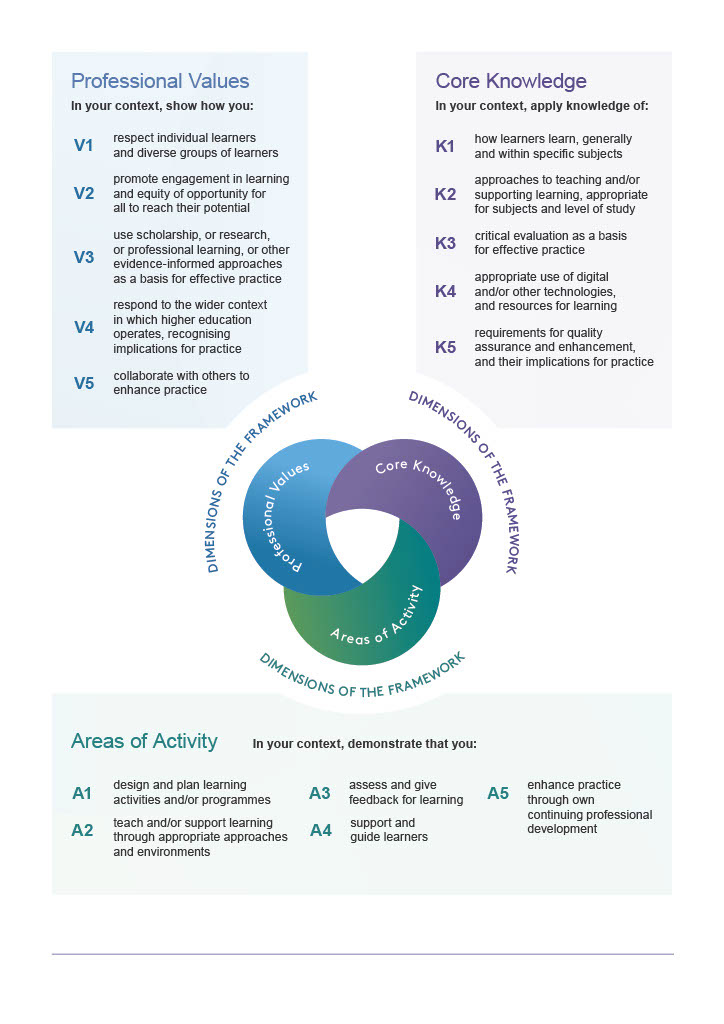
Image Source: Advance HE (2023) Professional Standards Framework for teaching and supporting learning in higher education 2023. Available: https://www.advance-he.ac.uk/teaching-learning/professional-standards-framework